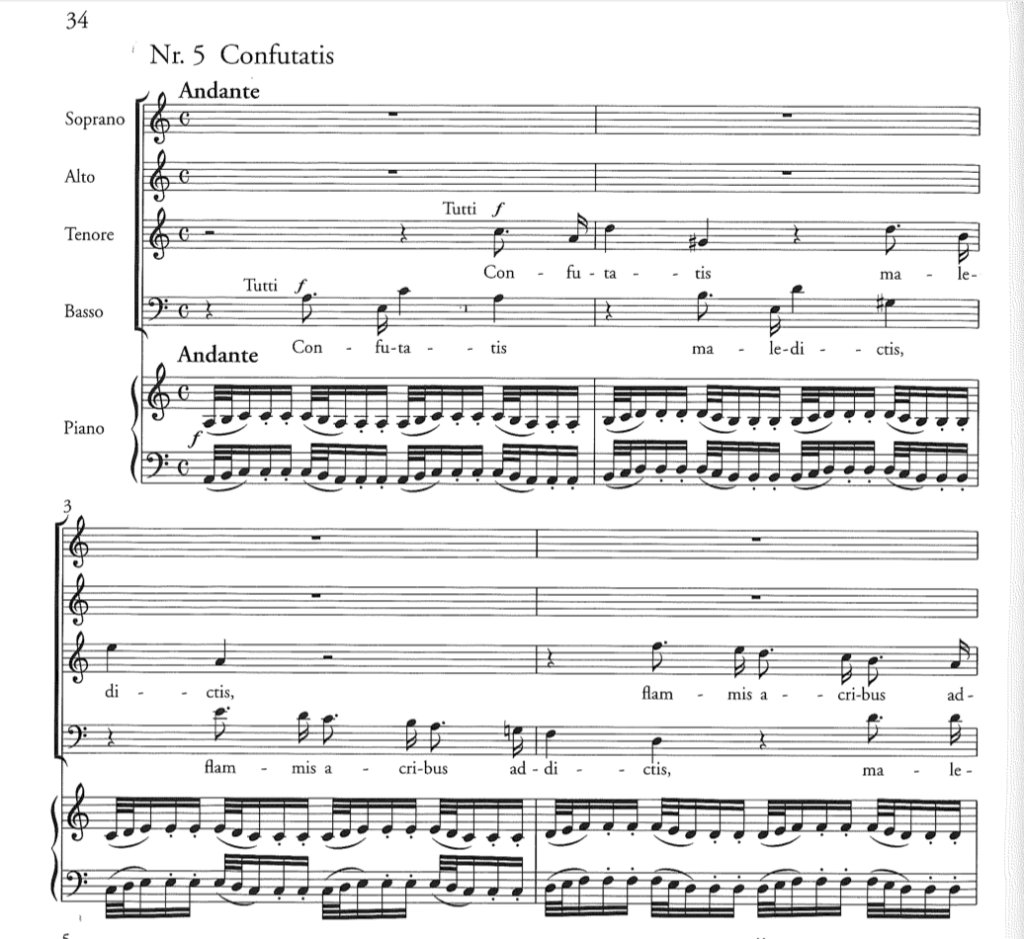
Following is a section from “A CCCC Requiem,” which will appear in JAEPL in fall 2026. I’d normally not disrespect a journal by pre-publishing anything, not even just an excerpt as I’ve done here. But in the last couple days, there’s been a version published of why the NCTE leadership, under Emily Kirkpatrick and Antero Garcia, killed CCCC only 6 days after receiving a report it demanded from the CCCC executive committee. I found that version “interested,” so much that I think there ought at least to be other interests represented. As you can see from the essay’s headings, I structured the JAEPL article in common movements of the requiem mass, with a reflection why. DH
Introit: A Loss, Personal [not included]
Dies Irae: What Happened in July 2026? [not included]
Confutatis: But Why Did This Happen?
There are three reasons for dissolution cited in the July 24 de-chartering statement: “In recent years. . . CCCC has struggled with its fiscal sustainability, declining participation, and governance challenges.” I’ll discuss each.
Declining Participation
Over the past 25 years, participation (membership and conference attendance) in CCCC has no doubt declined, following national trends documented across nearly all membership associations, whether in education or trade. A report covering some 40,000 associations noted, “Membership growth has fallen to new historic lows, renewal rates are softening, and the share of associations reporting membership declines is rising steadily” (MGI, 5). CCCC had around 3000 members at the time of its eviction, with about 2500 registrants for the Cleveland convention. Membership was down 37.5% from 2019, much a cost of the pandemic, no doubt, but with additional factors being the accelerating percentage of contingent faculty, the technology-driven turn to information alternatives to centrally curated resources, the response to a former chair’s address many found energizing and some found polarizing, and so on. A membership of 3000 was a 50+% drop over our 6846 members in 2003 (Williamson, 1).
Of course, NCTE membership had also declined about 50% over that same period, from 48,125 members in 2003 to about 25,000 estimated today, both paltry compared to the heyday of 1969 and its 120,243 members (Lindemann, Reading, p. 441 and p. 438). While I combed through NCTE Board of Directors reports for recent years, I couldn’t find reliable membership figures, although I infer that the membership has been at least stable in the decade since I was on the NCTE presidential team.
In fact, CCCC remained in July 2026 not only the oldest and most important organization in writing studies but also the largest. It is certainly larger than any of the other NCTE Conferences: ELATE (for teacher educators), CEL (for school English leaders, such as department chairs or curriculum coordinators), or LLA (formerly, the Whole Language Umbrella, which long has struggled with membership and finances and which the NCTE EC has worked to support over the years.) Should we be concerned about declining CCCC membership? Of course. Was I? Of course. That’s especially true when such a high percentage of people teaching college writers aren’t members of its most important professional organization. Was declining membership a cause for de-chartering? No.
Finances
Perhaps, then, finances. Per the March 6, 2026, report by Executive Secretary Treasurer Emily Kirkpatrick, CCCC had $4,567,072 cash from its investment accounts. Of that amount, $2,102,888 was in its required reserve fund. Following NCTE requirements, conferences are required to keep 150% of their annual budgets in reserve, to resolve debts and protect NCTE against loss. Practically, this means that if CCCC failed to collect even a single dime of dues, it could continue functioning for a year and a half before going broke. The other investments, some $2,464,184, were held in a “contingency reserve” fund, created by CCCC and funded whenever the organization had surpluses, as a fund to pursue strategic opportunities beyond the annual operating budget. (Since leaving the NCTE presidential team in 2017, I don’t know if CCCC has changed the guidelines that it created for itself.)
From the required reserve figure, I’ll extrapolate that CCCC’s operating budget was maybe $1.2 to $1.4 million. Conferences are required to pay NCTE 25% of their annual budget (the money cost to membership services, accounting, websites, registrations, and other support), meaning that CCCC was conservatively paying NCTE $300,000 annually, from members who were also members of NCTE. In her March 2026 report, Kirkpatrick noted that CCCC had a budgeted operating loss of $403,000, which meant the amount by which its income fell short of expenses in FY26. The difference needed then to come from investments. Now, even an old English professor like me understands that you can’t withdraw savings at 10% for very long without creating problems. I’m all for keeping things in line, including using investments around 4%, a standard spending rate. (NCTE itself likely relies that much on its own reserves to meet its operating budget.) But the point is that reserves and investments are, in fact, reserves and investments, existing to serve a purpose.
My informed impression is that the wolf was hardly at the CCCC door, though we needed to acknowledge that it was in the forest. In fact, CCCC had deeper reserves by nearly half a million in 2026 (and, to be honest, a bigger income shortfall) than in 2024, when it had $4,038,980. In 2024, Kirkpatrick direly warned that the continency reserves would be gone in seven years—and sooner if investments declined (Kirkpatrick, CCCC Secretary-Treasurer Report 2024). In 2025, the cliff was figured at 10 years, and although the 2026 report raised alarms, it identified no burning house. Emily Kirkpatrick was not available to give her report in person at the annual business meeting in 2026, 2025, or 2024, thus missing opportunities to answer member questions. I did ask one in Cleveland and noted her frustrating absence.
I apologize for glazing your eyes, but I’ve gone into the money weeds for a couple reasons. First is to put the financial state of things, already shared openly with members per CCCC bylaws, in one historical place. Second is to demonstrate that, while the budget needed correcting (and which I trust the CCCC Executive Committee did), there was no financial cause for the draconian action of axing a 77-year-old organization whose member dues had built a $4.5 million reserve.
So, It Comes to Governance?
I think so.
Governance has a couple elements. One is “the what.” What activities is a group engaging, what materials is it producing, positions promoting? An agenda that wanders from the mission, even by disproportionately investing in some enterprises and not others, without principle, raises concerns. It’s something that members of the group might well call out, using established bylaws and processes to stay a course. Perhaps the NCTE leadership thought the CCCC agenda had gone astray, although given those leaders’ lack of detail, I can’t say. Looking at CCCC decisions, I certainly can’t perceive what they found lacking. Were they put off by issues of diversity and inclusion that have been foregrounded in recent years, intwined as those are with matters of literacy in particular, schooling in general, especially in Donald Trump’s America? However, even if, as dangerously anointed Emperor of CCCC, I myself might have pursued a slightly different agenda in recent years, the one our elected body chose struck me as reasonable and capable of remedy from within, through petitions, resolutions, and so on. Again, I’m not privy to the thinking of the current NCTE leadership.
The other element is the “how.” How does the agenda get set and enacted? Who is at the table and what do they—or fail to do—when they get there? What are the by-laws, the ways of proceeding? Are they being followed? Again, with no detailed information from the NCTE leadership, I’d be foolish to speculate if their judgement derived from perceptions that CCCC Executive Committee, its various subcommittees, its forty-some standing groups, and so on were governing badly. The questions about priorities that CCCC was asked to address on June 15 suggests the NCTE leadership at best didn’t understand the organization’s priorities and how it was achieving them. At worst, they didn’t trust governance processes or elected individuals to carry them out. But, again, the box of explanation is pretty black.
Complicating things is that CCCC officers and executive committee member were, as I understand it, compelled to sign a nondisclosure agreement. I was on the NCTE presidential team until 2017, and at least until then, it would have been insulting to ask elected leaders to sign an NDA. Certainly, neither of two other organizations I’ve led have required them, though perhaps their stakes were trivial, with no threats from competitors, lacking an executive director and staff, or tens of millions in investments. Perhaps NDAs are common today in educational associations, and I’m just hopelessly naïve, more with each passing year. But I will say that the existence of NDAs, with highly prescriptive communication protocols, makes it difficult for members to understand what’s happening. Back in the dark ages, I kept a public CCCC Chair’s Blog, following the lead of Kathi Yancey before me. Those days are gone.
I will offer one impression of governance in CCCC since 2022. A CCCC subcommittee, co-chaired by Holly Hassel and David Green, revised the organization’s Constitution, overseeing a process that culminated in approval by the majority of members who voted. I voted no, perhaps because I’m a fusty traditionalist, but I thought the new composition of the Executive Committee significantly complicated the ability to complete the organization’s work, including meeting fiduciary responsibilities. The new group was large, 23 members. In addition to five elected officers, five seats were designated for Cultural Identity Caucus Representatives, three for TYCA, six for nominees from CCCC active Standing Groups, and one each from the Committee on Disability Issues in College Composition and the Diversity, Equity, and Inclusion Committee. Appointed (not elected) members were two Graduate Students. The remaining six members were at-large nominations, two of them required to be contingent faculty. Practically, this meant that over half a big executive committee comprised leaders whose initial orientation, at least, was to specific groups that nominated or appointed them (Structures).
Lacrimosa: What Have We Lost? [Not included]
Lux Aeterna: What May Be Reborn? [Not included]
Works Cited
CCCC Position Statements, Guidelines and Resources. NCTE, https://cccc.ncte.org/cccc/resources/positions
“CCCC Transition Team: Writing Studies and Rhetoric in NCTE and Beyond.” Aka “Transition Team Originating Document.” https://cccc.ncte.org/wp-content/uploads/2026/08/TransitionTeam_OriginatingDocument_August2026.pdf
“Chronology of Events Leading to the College Forum in NCTE.” NCTE Archives. In Archives of the University of Illinois Library, RS 15/73/13, box 1.
Gilyard, Keith. “Getting It Together: Notes toward a Shared Future for NCTE and CCCC.” College Composition and Communication, vol. 62, no. 3, Feb. 2011, pp. 539-549.
Godfrey, Jason and Anne Ruggles Gere. “The Crisis in College Composition and Communication.” Inside Higher Ed, 21 August 2026. https://www.insidehighered.com/opinion/views/2026/08/21/crisis-college-composition-and-communication-opinion
Hassel, Holly. “Transition Update #1, August 2026.” https://cccc.ncte.org/cccc/transition-team
Kirkpatrick, Emily. “CCCC Executive Secretary-Treasurer Report. CCCC Fiscal Year 2024 Financial Summary.” 5 April 2024. https://cccc.ncte.org/wp-content/uploads/2024/03/2024CCCCABM_EDReport.pdf
—. “CCCC Executive Secretary-Treasurer Report. CCCC Fiscal Year 2025. Financial Summary.” 11 April 2025. https://cccc.ncte.org/wp-content/uploads/2024/03/2025CCCCABM_EDReport.pdf
—. “CCCC Executive Secretary-Treasurer Report. CCCC Fiscal Year 2026 Financial Summary.” 6 March 2026. https://cccc.ncte.org/wp-content/uploads/2024/03/2026CCCCABM_EDReport.pdf
Lindemann, Erika. “How Well Are We Listening? Lessons from the Founding of NCTE and CCCC.” College Composition and Communication, vol. 62, no. 3 Feb. 2011, pp. 504-539.
Lindemann, Erika, Ed. Reading the Past, Writing the Future: A Century of American Literacy Education and the National Council of Teachers of English. National Council of Teachers of English, 2010.
MGI. Membership Marketing Benchmark Report 2026, 18th Edition. Marketing General. https://go.marketinggeneral.com/l/733823/2026-06-29/cwprt7/733823/1782746062p33Waqrv/The_2026_Membership_Marketing_Benchmarking_Report.pdf
“Statements of Support.” CCCC-Lorg. 24 August 2026. https://www.cccc-l.org/statements-of-support/
Structures and Processes Working Group, CCCC EC, 2020-2021. “Rationale for Proposed Changes to Governing Documents.” 2021. https://cccc.ncte.org/wp-content/uploads/2022/03/Rationale_Proposed_Changes_Governing_DocumentsSept2021.pdf
Williamson, Kent. “Conference on College Composition & Communication Notes to March 2006 Financial Report.” Agenda Item 7.C. Executive Committee Meeting Agenda, 22 March 2006.
“Writing Professors Leaving NCTE to Make a New Home.” 4 August 2026. https://wacclearinghouse.org/docs/new-home.pdf
Leave a Reply
You must be logged in to post a comment.