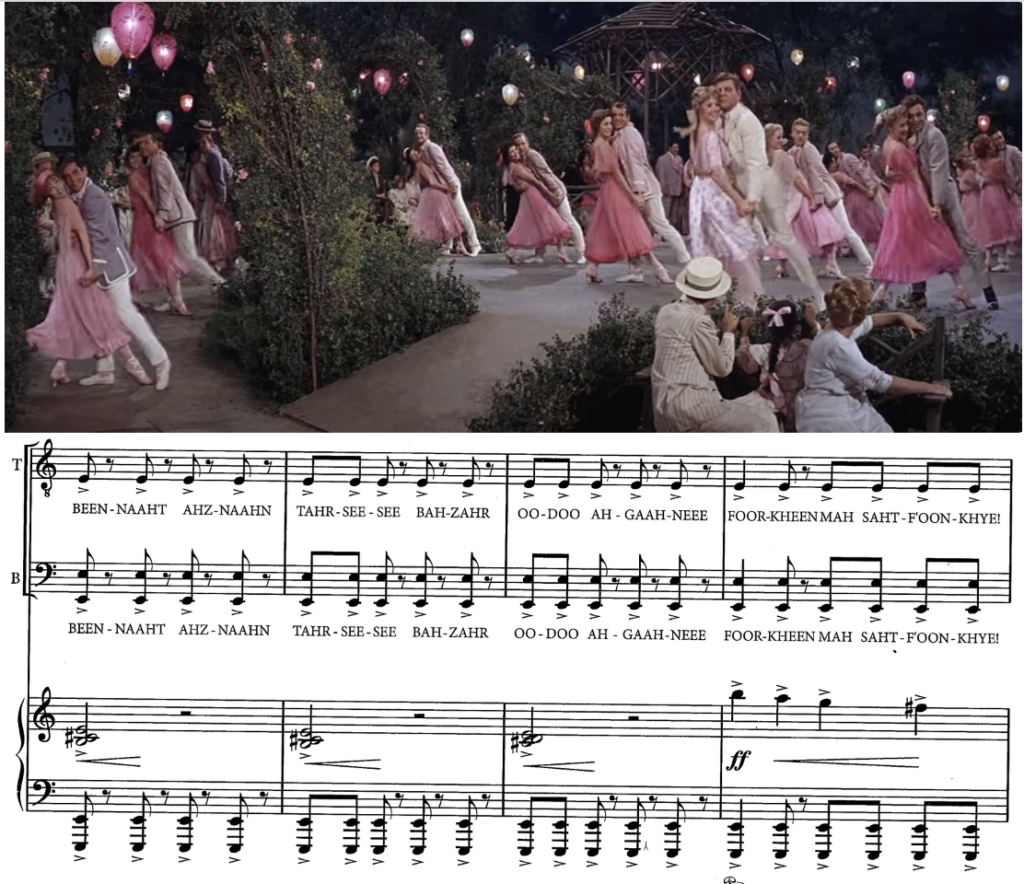
In 1992, I was in a Bloomington, Illinois, Community Players production of The Music Man, playing three ensemble parts, two of which involved considerable dancing. In the library scene I could barely pass as a town teen, dancing on tables and annoying Marian the Librarian. In the town park scene, we did that grandest of dances, the Shipoopi. I was always a fairly good singer, but in my undergrad days at Iowa, when I performed in the Old Gold Singers, a show choir, I learned to be a competent dancer. By competent, I mean if you taught me choreography, I could reproduce it reliably without embarrassing myself or hurting anyone.
But I nearly met my match with the Shipoopi. My dance partner was Sandra, a twenty-something woman whose day job was receptionist for my optometrist. Small midwestern cities mean encountering people across various unexpected domains, often through the arts, and so I found myself lifting, for a high kick, a woman who took my check and printed my prescription.
Before each of ten performances, Sandra and I would meet backstage to rehearse the dance. There was the lift, sure, and some polka steps and some fast grapevine, but the trickiest element was a series of alternating straight leg kicks, me kicking forward with a right leg, she kicking back with her left and vice versa. The trick was that these steps had occasional hitches, when through a hop, you’d disrupt the pattern. Because we were in close waltz position, chest to chest, there wasn’t room for error, meaning that if I messed up the count, I’d kick Sandra in the shin. We’d go through the sequence, softly counting in each other’s ear, “1-2, 1-2, 1 now change, 1-2,” inevitably messing up even toward the end of the run, though we always succeeded during the show.
[You can see the problematic sequence around 3:50 of this clip from the 1962 movie, starting first with Robert Preston and Shirley Jones, then picked up by the whole ensemble. But you really should watch the whole five minutes, especially with the inestimable Buddy Hackett.]
I thought of those repetitive drills last night during a rehearsal with the Colorado Symphony Orchestra and Chorus. This week we’re providing live accompaniment to the second movie in the Lord of the Rings trilogy, The Two Towers. Early on, there’s an extended sequence where the tenors and basses do a menacing Orc chant. The combination of nonsense words (and now I’ve just offended true fans who will explain the language to me with great sophistication), of time changes from 4/4 to 2/4 to 3/4 to 5/4, and of randomly interspersed three and four eighth-note bursts baffles me. I just can’t seem to get it into muscle memory, especially at quarter note = 176. Probably better singers than I have discerned a helpful logic. But I find myself ten minutes before every rehearsal plowing earnestly through the section, albeit with no Sandra as dance partner.
The whole matter has me thinking about artistic complexity needing brute force repetition to learn, something that seems anathema to the whole business of art. A lot of music or dance obviously requires rehearsal. Usually, things like finding an obscure pitch against a dense or distant accompaniment or negotiating a long melisma achieve the status of memorization and habit, so you no longer think of the challenge. It’s just part of you. But every now and then, habit fails to materialize and I’m stuck with conscious intention and the need to practice. I fear that the “Glamdring” movement of The Two Towers is my latest Shipoopi.
It’s hardly the only one. For example, after dozens of performances of Carmina Burana’s famous drinking song “In Taberna,” plus with easily over a hundred rehearsals, I’ve finally begun internalizing the rapid-fire Latin catalog of who drinks is drinking (from dogs to monks to moms and dads). Perhaps by the time I completely trade in classical music for simple hymns I’ll have the guts to go into a performance of “In Taberna” without a couple refreshers in my living room or car.
I started college as a chemistry major and remember being terrorized by calculus. In fall of my freshman year, I got a C in the honors section of Calc 1 into which I’d been place. I was really determined to fix this, come spring. So I spent probably 15 hours a week at homework, solving problems. Just brute force grinding. I ended up with a B in Calc 2. But I had no conceptional grasp of anything I was doing, no perception of logics behind the techniques, no intuitive sense. I figured this was not a good thing for someone hoping to work in the sciences, and I honestly thought I’d reached the limit of brute force. Maybe if there’d existed a Calculus for Dummies book in 1975, things would have been different, but I just decided to get out of Dodge. Calculus was no Peter Jackson movie, and I was kicking my own shins, not Sandra’s.
In the end, we choose our own Shipoopis.