 The end of July is fast approaching, which means a dwindling window for Summer Reading. Summer reading is a phenomenon marked by suggestions for generally lighter, easier fare, books suitable for hot vacation months, when brains deserve breaks from more sturdy menus. If winter reading is a stout or porter, summer reading is a pilsner.
An article by Craig Ferhman in the Boston Globe (August 12, 2012) traces this tradition back to the 19th century, when “effortless” novels began appearing on the summer lists that publishers and newspapers running, sort of as a public service. Fehrman quotes an 1872 Chicago Tribune characterization that “The best summer book was one ‘the idler can take with him into solitude, and read with delightful pauses, when with indolent finger upon the page, his eye wanders up some green vista, or catches some view of the distant sea, and his ear is soothed with the distant murmur of the winds and waves.’”
The apotheosis of such lists are things like Real Simple’s promising “beach reads,” which includes, to my surprise that venerable 1960’s The Valley of the Dolls. Most every newspaper from The New York Times to the LA Times publishes recommendations each June. Variants on mere lists include “What I’m Reading” stories, in which people of various stripes recount what’s currently on their night stands or in their backpacks. There’s a kind of one-upmanship quality to these compilations, which are often heroic in their scope and challenge. See this New Yorker story for an example of the genre.
Of course, “summer reading” means something else to legions of American students. I’ll set aside the many library reading programs, where kids check off titles for pizza or prizes. For many students, summer reading means assigned reading: a book or two that students are “responsible for” by September. Denver East High School publishes a pdf of books required for individual classes, with the somber advice, “The books need to be completed by the first day of school, August 2016.” It provides a 7-bullet answer to “Why Summer Reading?” (including “provides academic focus for the 1st day of school” and “helps shrink the achievement gap.”) English I students, for example, are to complete Ray Bradbury’s The Illustrated Man, while Creative Writing II students face Julie Otsuka’s The Buddha in the Attic.
For other students, summer reading lists are suggestions accompanied by some Benjamin Franklin-grade injunction for self-improvement. Overland High School, in Aurora, Colorado, heads its list with a multi-colored, in-your-face all-caps warning, “Hey, You!” which I’ve pictured above. Colleges often participate in “one book” projects, while some, like Berkeley, put out an annual “nonrequired summer reading list” for incoming students. Berkeley’s 20 titles range from The Little Prince to The Making of the Atomic Bomb. Occasionally, school summer reading becomes controversial; in a recent blog post, Millie Davis describes how the National Council of Teachers of English Intellectual Freedom Center receives requests for help with book challenges (i.e. censorship cases), including one where librarians in one school district were accused of promoting pornography through their summer list.
#
Forty years ago, I was home from college after my sophomore year at the University of Iowa, and I read hugely. I’d go to work with Dad at 6:00 am, heaving garbage into the back of the trash truck he owned with Fred Behr. Most days, we’d finish the route by 2:00 or so. Until supper time, I’d read in the living room, the only one with a window air conditioner or, maybe on the porch. A couple days a week I’d go the DeWitt Public Library. After supper, I’d play tennis at the high school courts, sometimes with my girlfriend, Dianne, sometimes with Paul Carlson or Dave Farus. Regularly, we’d go after dark over to Becky and Sara Ash’s house, where there’d be two tables of bridge until 11:00 or so. Repeat the next day.
I remember that summer of reading because it followed my first year as an English major. I realized there was no chance of reading everything in classes. So I’d better step up my game. I read Jane Austen, who I liked a lot. I read Robert Penn Warren, John Dos Passos, and Dickens. I remembered three books in particular, Barbara Tuchman’s The Guns of August, E.F. Shumacher’s Small is Beautiful: Economics as if People Mattered, and Robert Pirsig’s Zen and the Art of Motor Cycle Maintenance, which troubled me. (I read it again a couple years later and experienced the same effect.) At the library, I read magazines, most notably as much of The New Yorker as I could, especially the long nonfiction pieces, which really confused me. In particular I remember reading these long essays by Saul Bellow about traveling to Israel. I’d encountered Bellow in two classes at Iowa: Herzog in Carl Klaus’s writing class focusing on style, and Henderson the Rain King in an American lit class, so I figured I should pay attention to him. The pieces perplexed me, as I remember, a mixture of memoir and journalism and some political commentary. They didn’t fit any genre that I knew, and it was sort of exciting to see pieces that were breaking all the rules in my limited understanding.
I remember enjoying all this reading, though I suspect my odd assortment didn’t quite fit the beach reading bill. It was a lot of serious stuff, even the Dickens. I was an earnest kid who knew time was short and the world was wide.
Now, forty years later, time is even shorter, the world even wider, and I’ve resigned myself that hundreds and thousands of important books will go unread. Perhaps it’s a sign that I’ve given up or sold out, but this summer I’ve finished reading Walter Moseley’s smart detective series, both the Easy Rawlins novels set in Los Angeles and the Leonid McGill novels set in New York. I’m reading an OK murder mystery, Los Alamos, by a writer new to me, Joseph Kanon, and I’ve got the latest Stephen King book queued up on my Kindle.
Maybe next year I’ll get to the most recent work by Slavoj Zizek. Or maybe next. Or the one after. After all, summer waves are gently lulling, even here at the foot of the Rockies, miles from any lakes or oceans.

Doug
 After 26 school kids and teachers were slaughtered in Sandy Hook, we collectively shrugged at even minimal measures to reduce gun violence. (For the record: I grew up in a hunting culture, and while I no longer hunt, I understand and respect owning shotguns and rifles. My Uncle Harold was a national champion trapshooter, and I understand the culture of target shooting and even the joy for many of shooting for pleasure.)
 Teacher appreciation week 2016 conjures many strong English teachers that have made a terrific difference in lives of people close to me. I think foremost to my own children’s teachers, in high school and earlier. Susie Thetard, Diane Walker, Claire Lamonica, Bob Neuleib, and Kathy Clesson, each at various times NCTE members, taught my three kids extraordinarily well, in both the practical and the creative arts of language. They inspired writing as well as reading, speech and theatre as well as classroom English. Like so many good teachers I know, they’ve followed with keen interest what my kids have been up to well after graduation. Normal, Illinois, did well.
 April is poetry month. I thought of this poem I wrote years ago, for Andrew’s last high school chorus concert. (The school colors were green and yellow).
 Yesterday, I received the following email from a local high school student. I’m pretty sure my reply was less helpful than she might have wanted, but the questions didn’t lend themselves to the more direct answers I’m guessing that she and her teacher had wished for. I hope she writes back.
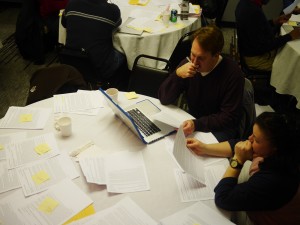
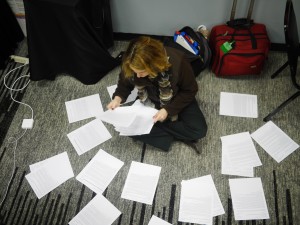 This is one of the more exciting weeks each year in life of NCTE. In the space of four energetic days in Washington, DC, three things happen: Advocacy Day, an Executive Committee meeting, and Annual Convention Planning. Last year we were greeted by a snowstorm that shut the federal government; I’ll be happy not to have that drama this time around. I’ll tell you about each of these activities, starting in this post with the convention planning process.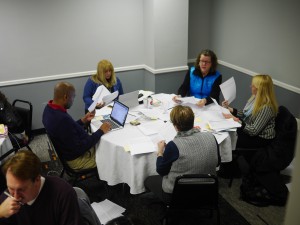
 Level Two
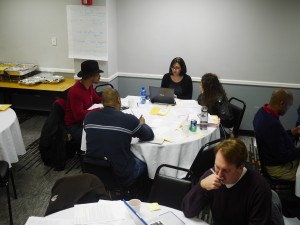 Let’s imagine that you checked “Whole Language” for your proposal on “The Apostrophe” because you were emphasizing ways of teaching this kind of punctuation that fit the principles of whole language instruction. (Humor me!) Let’s imagine, further, that the Secondary group determined that your proposal wasn’t one of the 150 it could accept. But there’s also a Whole Language review team, which convenes along with other review groups. They look at all of the Whole Language-designated proposals and choose those that best meet the spirit of the strand. They, like the other Strand groups, have an allotment of program slots they can fill (let’s imagine 10 of them) above and beyond the ones apportioned previously. Of course, your “Apostrophe” proposal may well have been accepted by the Secondary group. Congratulations! If the Whole Language reviewers agree that it meets their criteria, it will show up in the program with the strand designation, and they’ll be able to use their program slots for something else.
 needs of NCTE members.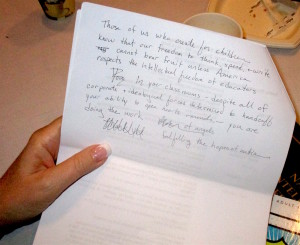

 December 20, 2015
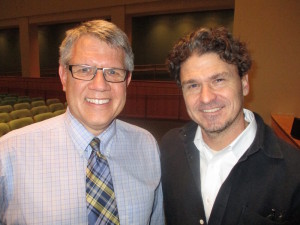 ny/poignant story of a young teen boy with a vision-occluding zit who audaciously proposed giving a speech on bicycling to the inner mantel of the earth (“because it would be downhill all the way”), only to have a remarkable teacher tell him to go for it. That teacher—Eggers’ own high school teacher, Peter Ferry—was in the audience and came to the stage with thunderous applause, where Eggers gave him the wrapped manuscript of his next book.
 Not long after the convention, of course, Congress passed and Obama signed a new bill to replace No Child Left Behind. The new Every Student Succeeds Act has hundreds of parts, but a key element is to return many responsibilities to the states, including how they adopt Common Core standards and how and when they administer tests. Whether NCTE members experience these changes as positive ones depends significantly, of course, on what their states choose to do with the latitude they’ve been giving. The NCTE Policy Analysts network will no doubt be busy.