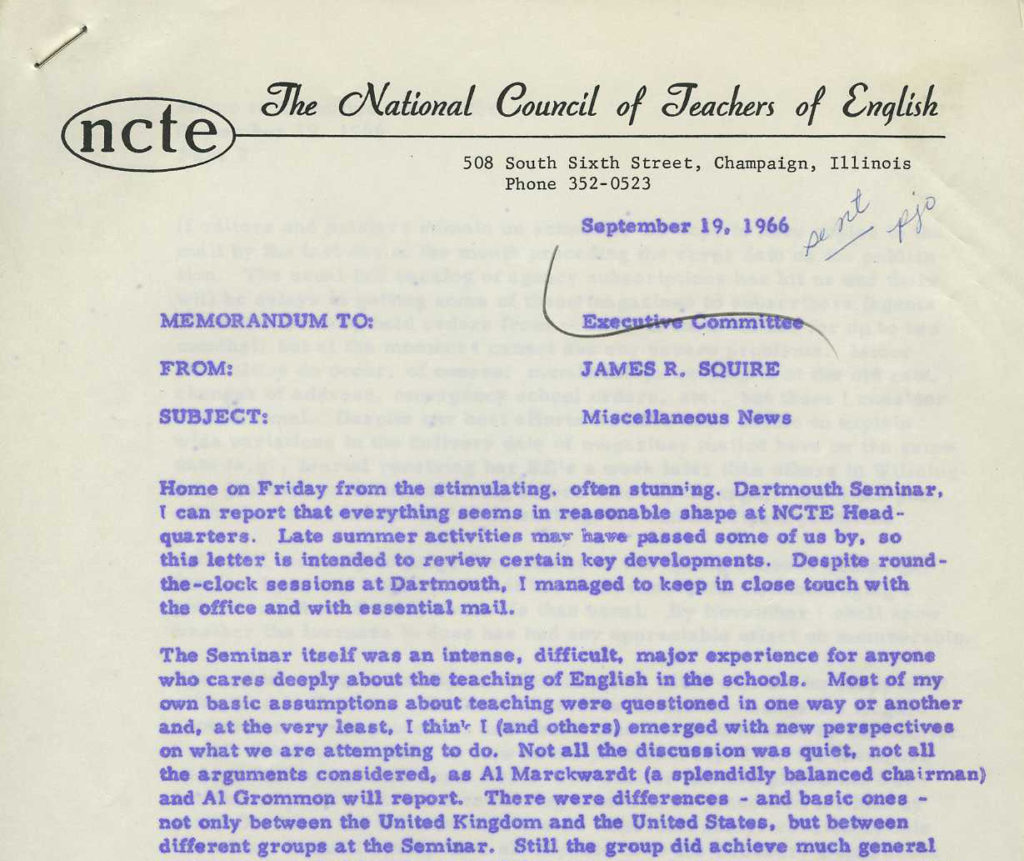
 August 2016 marks the 50th anniversary of the “Anglo-American Seminar on the Teaching of English,” a landmark juncture for how English teachers in America and Great Britain viewed their subject, responsibilities, and classrooms. Participating in the month-long seminar were 21 British teachers, 24 Americans, and a Canadian, with a generous handful of consultants attending part-time.
Two official books about the conference, appearing in 1967, and shorthand synopses ever since have characterized the meeting as a clash of cultures. In this formulation, the Americans were methodical, preoccupied with structured curricula, and focused on the subject matter. The British, on the other hand, were spontaneous, concerned with language in practice, and focused on student personal growth. To the British, the Americans seemed stodgy and authoritarian. To the Americans, the British seemed muddling and slack. Or so the characterization goes. It’s fair to say that participants from both countries marked respective avant-gardes, so their rank-and-file representativeness is a question. It’s also fair to say that contrasts make better drama, as in the ill-fated 2016 block-chipper Batman v. Superman. Nonetheless, the issues that framed the meeting were generative then and remain so today. More on that later.
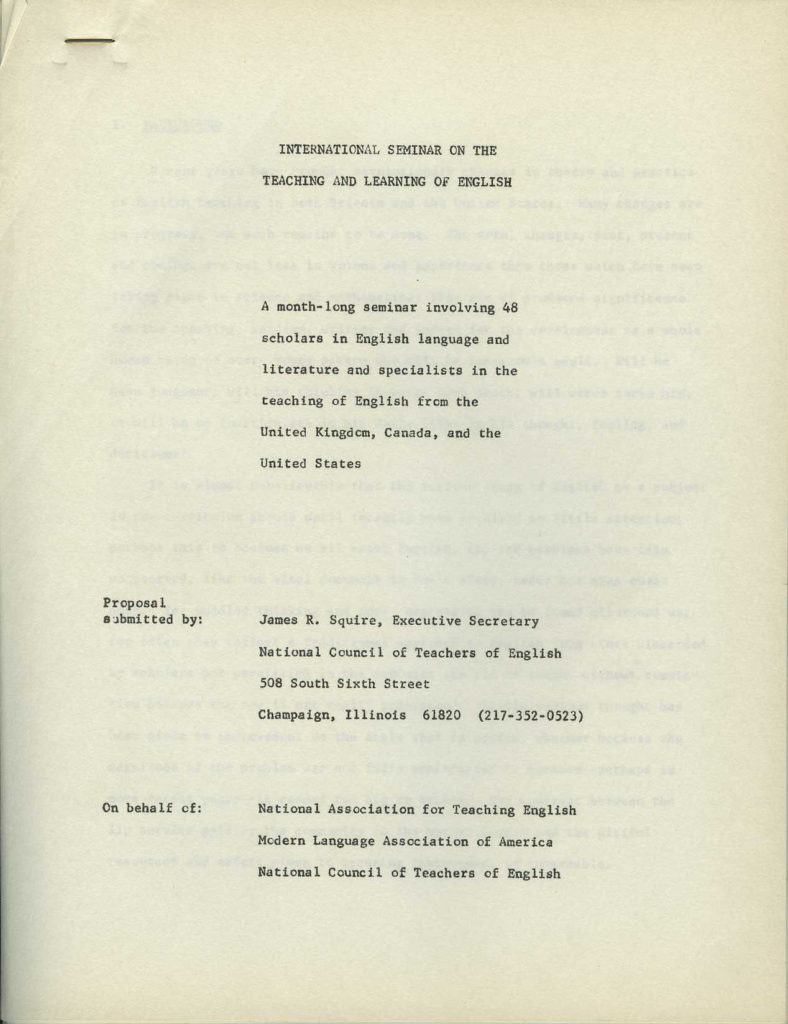
The meeting was held at Dartmouth College, a circumstance that led to its usual shorthand reference as the Dartmouth Conference. James Squire, then Executive Secretary of the National Council of Teachers of English, wrote a grant proposal to the Carnegie Corporation, which funded the event. Partners in the collaboration were MLA and NATE (the National Association of Teachers of English, the British counterpart of NCTE), and the representatives from each group (overwhelmingly male, not surprisingly) are a sort of who’s who of the era: Wayne Booth, James Britton, James Moffett, Albert Kitzhaber, John Dixon, and so on.
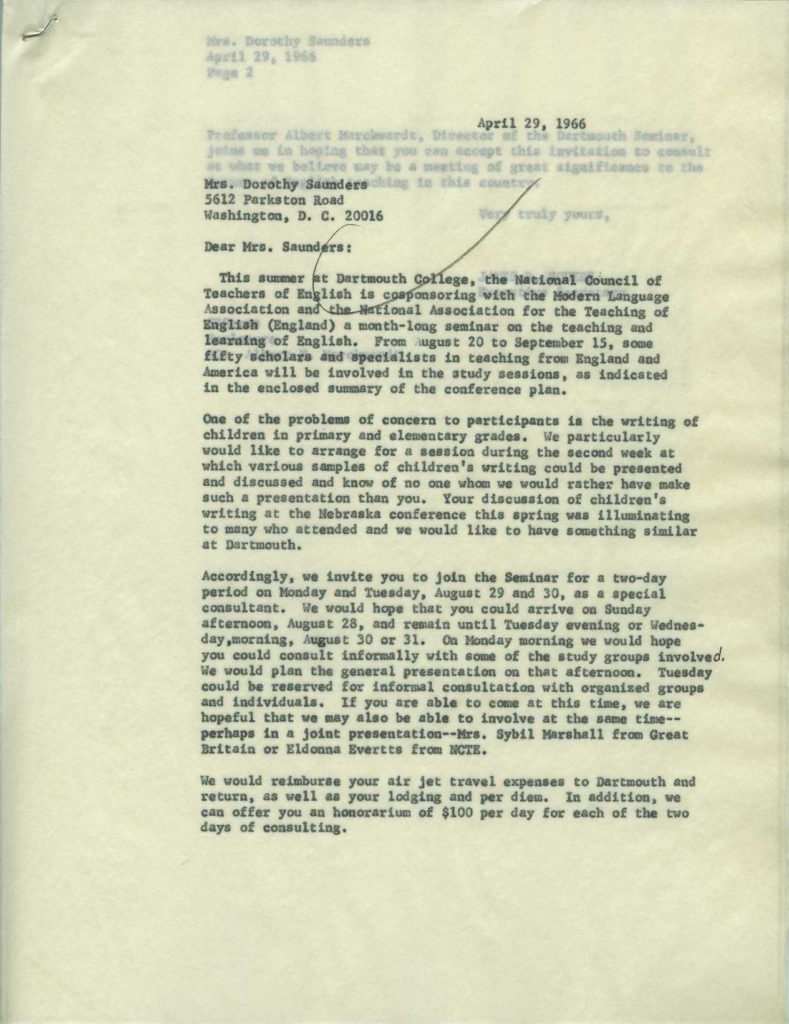
Of course, the seminar organizers perceived early on that this largely professorial entourage had scant input from classroom teachers. I was happy to come across a letter in the NCTE archives from Squire to Dorothy Saunders, an elementary teacher in Bethesda, Maryland, inviting her to serve as a consultant to talk about her students’ writings, offering “air jet travel expenses” and a $200 honorarium.
A few things stand out as I glanced back to the archives and to the official books, Herbert J. Muller’s The Uses of English (Holt, Rinehart, and Winston, 1967) and John Dixon’s Growth in English (NATE, 1967). For example, Squire’s funding proposal uses a rationale that will sound familiar in our present-day STEM-centric circumstances. Needed changes in theory and practice for English teaching, he wrote, “are not less in volume and importance than those which have been taking place in science and mathematics.”
The relationship between “the creative” and “the practical” also remains familiar, at a current moment that weighs education primarily for its economic and vocational benefits. British teachers were found then to put considerably more stock in creativity as foundational to “developing the child’s capacity to explore and express his inner world” (Muller 116). Americans were skeptical. In his book A Long Way Together: A Personal View of NCTE’s First Sixty-Seven Years, J.N. Hook describes how “British children wrote more, and they wrote more freely,” while “American children almost certainly wrote less than they needed to, and their teachers were beset by a compulsion to correct not only every jot but also every tittle” (221).
I’m fairly confident that teachers on both sides of the ocean have long modulated this polarity. We know, for example, that people learn to write by actually writing, not by being told rules and strategies, just as people learn to play piano by actually playing piano, not by hearing lectures on finger placements. We know that effective writers have learned, through long practice over time, to adapt their writing to meet readers’ expectations in specific situations and their associated genres; no writer is wholly “free” from history and expectations. But we also know that all writers, especially young ones, need engaging and authentic tasks to foster the long hours of practice needed to develop their skill and craft. The best encapsulation of what we need to do to develop student writing is the NCTE statement on Professional Knowledge for the Teaching of Writing
Fifty years after Dartmouth, English teaching in America still tries to find the right line between spinach approaches (“teach what can be practically tested, to demonstrate that you have achieved skills”) and ice cream approaches (“create opportunities for exploration and engagement”). Clearly, there needs to be a mix. Even more fundamental is the very purpose of the English curriculum at all. The most vocal and powerful pundits and policymakers tend to prize reading and writing almost entirely as pathways to employment, with a dab of cultural heritage, through literature, on the side.
I surely don’t discount economic advancement as a vital consequence of literacy. English teachers K-16 need to have that aspect centrally in mind. But job skills can’t be our only focus. In framing the “Anglo-American Seminar,” James Squire underscored the significance of speaking, reading, and writing for “the development as a whole human being of every young person who will be tomorrow’s adult. Will [he or she] have judgment; will [his or her] thinking in words have depth; will words serve [him or her] or will [he or she] be inarticulate in daily life—in [his or her] thought, feeling, and decisions?”
As I view our current social and political scene, surely we need “thinking in words” with depth and judgment. We need articulate ideas, not slogans or factless bravado. We need words—understanding as well as expression—a whole lot more than we need bullets or bombs or trucks down a tourist-filled boardwalk.
Two other thoughts, looking back on Dartmouth.
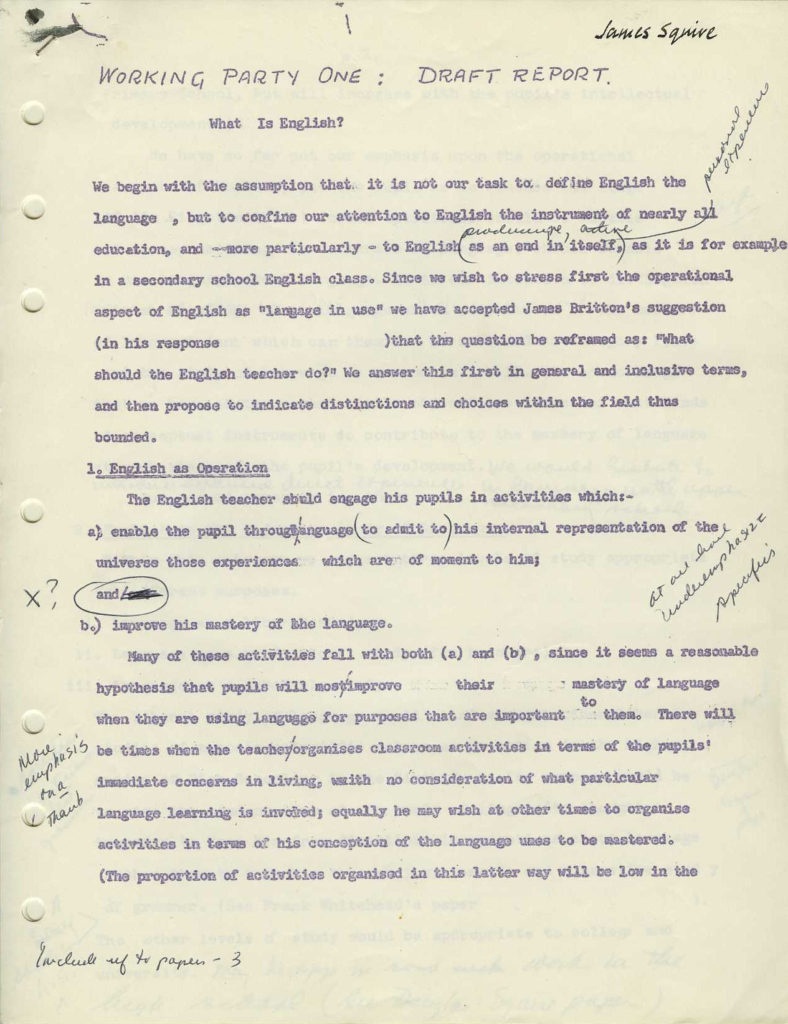
In his concluding chapter, John Dixon notes that “modern industrial society has recently moved strongly to a discussion culture,” one that emphasizes “public exchange of ideas rather than private writing and reading” (111). Dixon contemplates a multimodal world in which print literacy is but one mode of many, going on to forecast that “by the 1980s two-way television and telephone references libraries. . . may well be widespread” (112). If he’d only known. One of the earliest tasks of the Dartmouth participants was answering the disarmingly simple question, “What is English?” by which they realized the territory was considerably more expansive and complex than grammar rules and a certain literary canon. It was a body of knowledge, yes, but also a set of experiences with and dispositions toward language, in all its multiple forms. We’re still pursuing that question, quite rightly.
Last, a more personal note. In one of my first graduate courses at Iowa, back in 1978-79, we read James Britton’s The Development of Writing Abilities, 11-18, a study of British school children. I remember grasping his idea that language was a tool for thinking, not just a vehicle for conveying thought. Children—all of us—use language for making sense of things, for interpreting the world and putting it together. Schools needed to make a place for that kind of engagement. The idea underpins the whole notion of writing to learn and the writing across the curriculum movement. Britton’s idea struck like lightening, one of those few times that I can distinctly perceive a fundamental shift in my understanding.
A year or so later, Britton came to Iowa City, as part of the National Endowment for the Humanities Iowa Institute on writing led by Jix Lloyd-Jones, Carl Klaus, and many others. I was star struck. Here was one of the Dartmouth Conference Brits embodied in the heartland, in fact drinking beer with American colleagues and lowly grad students in George’s on Market Street. But that’s another story.
Meanwhile, here it is fifty years after The Anglo-American seminar, a fine moment for NCTE as a leader along with its sister organizations, and here I am, its unlikely president.
 The end of July is fast approaching, which means a dwindling window for Summer Reading. Summer reading is a phenomenon marked by suggestions for generally lighter, easier fare, books suitable for hot vacation months, when brains deserve breaks from more sturdy menus. If winter reading is a stout or porter, summer reading is a pilsner.

 After 26 school kids and teachers were slaughtered in Sandy Hook, we collectively shrugged at even minimal measures to reduce gun violence. (For the record: I grew up in a hunting culture, and while I no longer hunt, I understand and respect owning shotguns and rifles. My Uncle Harold was a national champion trapshooter, and I understand the culture of target shooting and even the joy for many of shooting for pleasure.)
 Teacher appreciation week 2016 conjures many strong English teachers that have made a terrific difference in lives of people close to me. I think foremost to my own children’s teachers, in high school and earlier. Susie Thetard, Diane Walker, Claire Lamonica, Bob Neuleib, and Kathy Clesson, each at various times NCTE members, taught my three kids extraordinarily well, in both the practical and the creative arts of language. They inspired writing as well as reading, speech and theatre as well as classroom English. Like so many good teachers I know, they’ve followed with keen interest what my kids have been up to well after graduation. Normal, Illinois, did well.
 April is poetry month. I thought of this poem I wrote years ago, for Andrew’s last high school chorus concert. (The school colors were green and yellow).
 Yesterday, I received the following email from a local high school student. I’m pretty sure my reply was less helpful than she might have wanted, but the questions didn’t lend themselves to the more direct answers I’m guessing that she and her teacher had wished for. I hope she writes back.

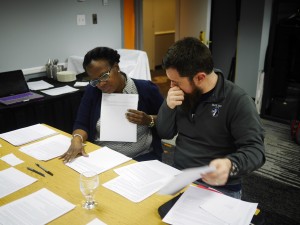
 This is one of the more exciting weeks each year in life of NCTE. In the space of four energetic days in Washington, DC, three things happen: Advocacy Day, an Executive Committee meeting, and Annual Convention Planning. Last year we were greeted by a snowstorm that shut the federal government; I’ll be happy not to have that drama this time around. I’ll tell you about each of these activities, starting in this post with the convention planning process.

 Level Two
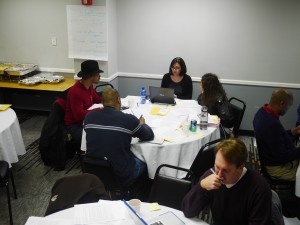 Let’s imagine that you checked “Whole Language” for your proposal on “The Apostrophe” because you were emphasizing ways of teaching this kind of punctuation that fit the principles of whole language instruction. (Humor me!) Let’s imagine, further, that the Secondary group determined that your proposal wasn’t one of the 150 it could accept. But there’s also a Whole Language review team, which convenes along with other review groups. They look at all of the Whole Language-designated proposals and choose those that best meet the spirit of the strand. They, like the other Strand groups, have an allotment of program slots they can fill (let’s imagine 10 of them) above and beyond the ones apportioned previously. Of course, your “Apostrophe” proposal may well have been accepted by the Secondary group. Congratulations! If the Whole Language reviewers agree that it meets their criteria, it will show up in the program with the strand designation, and they’ll be able to use their program slots for something else.
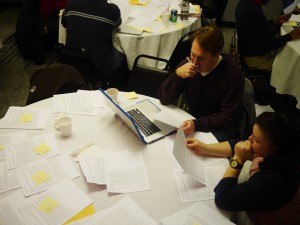 needs of NCTE members.